
From Low-Code to Full-Code: Task-Oriented vs. Thought-Oriented Teams in Software Development

I specialize in developing object-oriented java applications that aligns with business objectives, using Domain-Driven Design principles to ensure technical decisions drive tangible value. By focussing on a deep understanding of the business domain, I craft solutions that solve real problems while maximizing ROI. My approach evaluates the cost/profit ratio of every decision—only implementing technologies when the benefits outweigh the costs. I’ve been called in to revive stalled projects and address challenges where others have struggled. My focus is on creating software that not only meets but exceeds business expectations. Whether working with legacy systems or modern frameworks, I select the right technologies to maximize value—not just follow trends. I believe software should be a strategic asset, and this mindset guides every decision I make in development.
Software development teams face constant pressure: deliver more features, faster, and with scalable, maintainable systems. Choosing the right approach—low-code, less-code, or full-code—determines whether a project thrives or struggles. Each approach demands different skills, from juniors executing assembly-like tasks to senior developers capable of conceptual thinking. Low-code platforms excel for simple apps with task-oriented teams, while complex systems benefit from thought-oriented teams focused on domain-driven design. Understanding when each approach works, and when leadership should intervene, is critical.
Defining the Spectrum: Low-Code, Less-Code, and Full-Code
Low-Code: Platforms like Mendix, OutSystems, or Bubble provide visual interfaces and pre-built components. Developers—or even business users—assemble apps using a domain-specific language with minimal coding. It’s like IKEA furniture: follow the instructions and you have a functional product quickly, with little domain knowledge required.
Less-Code: Frameworks like Spring Boot or .NET Core give you some code while handling boilerplate via annotations, auto-configuration, and templates (e.g., @Service, application.yml). You write some code, but the framework reduces repetition. Think of a semi-custom IKEA kit: you assemble, but you have more freedom and responsibility.
Full-Code (Domain-Driven OO): Here, developers model the domain explicitly. Rich objects like Scenario in fraud detection or ProcessBucket for S3 storage encode responsibilities, not just data. Full-code is craftsmanship: slower to start, but precise, flexible, and sustainable.
As you move from low- to full-code, abstraction decreases and senior, conceptual skills become more important. Low-code maximizes junior productivity; full-code requires deep understanding of the domain and design.
Skill Requirements: From Task-Oriented to Thought-Oriented Teams
Low-Code: Easy for juniors to assemble functional apps quickly. Task-oriented teams follow tickets and complete defined tasks without deep domain insight.
Less-Code: Mediors write services and APIs, handling procedural logic. They still focus on task completion, but frameworks reduce the manual effort needed.
Full-Code: Seniors model responsibilities explicitly. Teams discuss “what” before coding, prototype, and refine implied rules. Thought-oriented teams work conceptually: the code reflects the domain, not just scaffolding.
Complexity and the Gains from OO
The advantages of OO modeling depend on domain complexity:
Low to Medium Complexity (say 0–30 entities, shallow rules): Low- or less-code teams can deliver functional, maintainable software with mediors. OO modeling helps, but the explicit benefits are smaller. Complexity is manageable; task-oriented teams can work efficiently without full domain models.
High Complexity (30+ entities, evolving domains): Explicit OO modeling shines. Rich domain models absorb complexity, reduce coordination overhead, and make adaptation fast. Small squads of senior OO developers (2–3) often outperform larger mediors-based teams—not just in calendar speed but in sustained delivery: over time, they produce more valuable features per unit of developer effort, the original quality indicator from Part 1. While the upfront cost of senior developers may seem higher, the long-term efficiency gain compounds: fewer reworks, lower maintenance, and faster iteration make senior OO teams far cheaper in the bigger picture. They row the Japanese boat, achieving both speed and stability.
This demonstrates that the tipping point for OO isn’t about speed alone. Low- and less-code approaches are feasible and effective up to medium complexity. Beyond that, thought-oriented teams modeling responsibilities explicitly are the most efficient, sustainable solution.
Task-Oriented Teams: How Learning Stalls
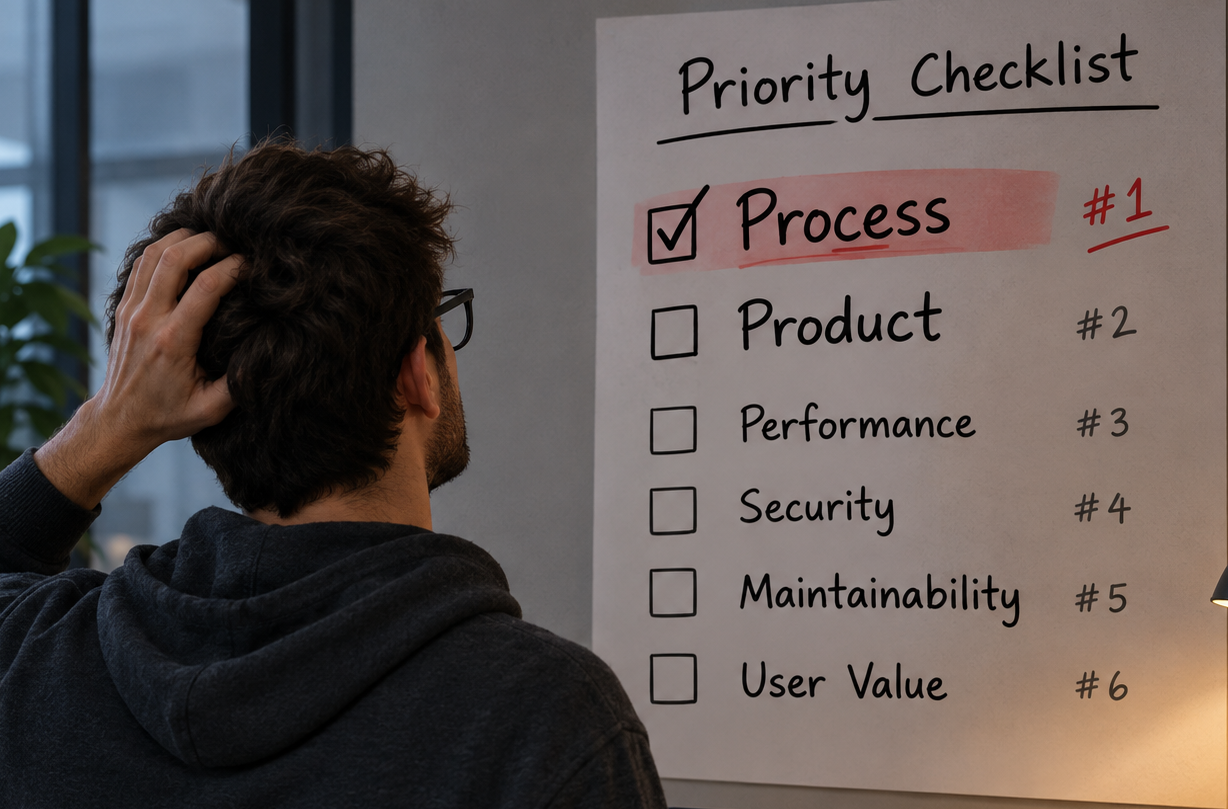
When teams only focus on delivering outcomes—hitting deadlines, passing tests, or satisfying metrics—their learning is constrained. Task-oriented teams get better at the process: writing unit tests, following templates, passing CI checks. But they rarely gain insight into the domain itself. Quality becomes “does it work?” rather than “is the design sustainable?” Over time, inefficiencies compound, more people are added, and the system becomes harder to maintain—a slow Dutch boat.
Thought-Oriented Teams: How OO Breaks the Cycle
Object-oriented, responsibility-driven design makes the domain explicit. Using rich objects like ProcessBucket and PermanentBucket for S3 storage, or Scenario in fraud detection, the team encodes both responsibilities and rules. Discussion becomes easier, shared vision improves, and changes remain localized. Small squads (3–4 developers) can manage hundreds of domain entities efficiently. Feedback loops are fast, knowledge is transferable, and system stability is high.
Advantages of this approach:
Implicit requirements surface early.
Non-developers can understand domain objects.
Implementation and rules are centralized.
Readable, business-aligned code.
Easy adaptation to new requirements.
Isolated testing without heavy mocking.
Reusable across systems.
Scalable design as the domain grows.
Encourages conceptual thinking.
Resilient to framework or infrastructure changes.
When Leadership Should Intervene
Leaders must recognize when task-oriented teams hit complexity limits. Up to medium complexity, low- and less-code teams work efficiently. Beyond that, investing in thought-oriented teams is often cheaper and faster in the long run. Mentorship and small squads allow mediors to upskill toward OO thinking. The payoff: smaller teams, clearer designs, and faster delivery—without the band-aid solutions or long-term rebuilds.
Conclusion: The Japanese Boat Wins
Low- and less-code approaches are valuable for simple to moderately complex systems: they are easy to staff and allow mediors to deliver quickly. But as systems grow in entities, rules, and evolving requirements, explicit OO modeling becomes the sustainable path. Small, senior squads working conceptually—thinking about responsibilities and domain rules—outperform larger task-oriented teams in cost, speed, and maintainability. The lesson is clear: row smarter, not harder. Build the Japanese boat: focus on design, clarity, and learning to win in complex software development.