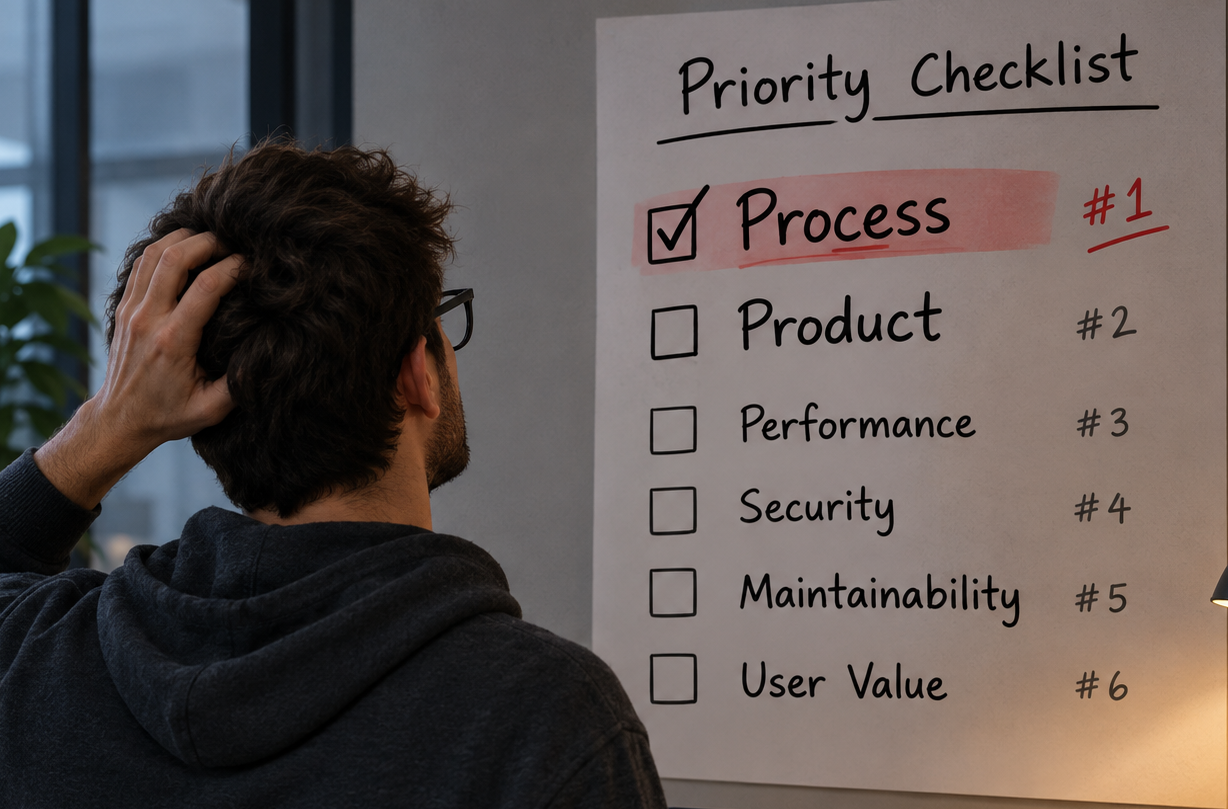

How to Recognize an Effective Software Engineer

I specialize in developing object-oriented java applications that aligns with business objectives, using Domain-Driven Design principles to ensure technical decisions drive tangible value. By focussing on a deep understanding of the business domain, I craft solutions that solve real problems while maximizing ROI. My approach evaluates the cost/profit ratio of every decision—only implementing technologies when the benefits outweigh the costs. I’ve been called in to revive stalled projects and address challenges where others have struggled. My focus is on creating software that not only meets but exceeds business expectations. Whether working with legacy systems or modern frameworks, I select the right technologies to maximize value—not just follow trends. I believe software should be a strategic asset, and this mindset guides every decision I make in development.
In software development, confidence is cheap.
You can memorize frameworks, quote architecture patterns, and repeat industry “best practices.” After a few years, it becomes easy to sound like an expert.
But none of that proves someone is thinking like an engineer.
The real signal appears the moment their ideas are questioned.
Real software engineers welcome scrutiny.
Weak engineers resist it.
That difference sounds subtle — until you see its consequences on the systems they build.
Engineering is not about defending ideas.
It’s about breaking them before reality does.
Engineering Is Adversarial — Against Your Own Ideas
Every engineering discipline assumes designs are wrong until proven otherwise.
Bridges are stress-tested.
Aircraft parts are pushed to failure.
Mechanical designs go through brutal review cycles.
The goal is simple: find weaknesses early, when they’re cheap to fix.
Software should work the same way.
Design discussions and architecture reviews exist to expose flaws before they reach production.
Strong engineers instinctively understand this.
When someone challenges a design, they respond with curiosity:
“Good point. Let’s walk through that scenario.”
Every challenge is free stress-testing of the idea.
The Moment Engineering Turns Into Dogma
The opposite mindset is easy to spot. Ask a simple “why” question about a design, and the response sounds like:
“Everyone does it this way.”
“That’s the best practice.”
“That’s the standard architecture.”
“That’s how the framework expects it.”
Notice what’s missing: reasoning, trade-offs, context — replaced entirely by authority.
Dogma is attractive because it removes responsibility. If a rule exists, you can apply it everywhere without thinking.
But real systems are messy. Constraints differ. Scale differs. Failure modes differ. Engineering requires reasoning. Dogma replaces thinking with imitation.
Why This Matters
This difference shapes the systems teams build.
Teams that welcome scrutiny produce software that is:
simpler
easier to modify
resilient to edge cases
understandable by new engineers
Teams that avoid scrutiny accumulate:
accidental architecture
unnecessary abstraction layers
rigid patterns nobody understands
rules that exist only because “that’s how we do it here”
Over time, these systems become fragile. Ironically, teams most confident in their “best practices” often maintain the most brittle codebases.
The Quiet Signal
Strong engineers share one surprising trait: they are comfortable being wrong.
Not because they lack confidence, but because they understand: ideas improve under pressure.
If a flaw is pointed out in a discussion, it’s removed before it reaches production. That is not a loss. That is engineering at work.
The Real Difference
Weak engineers defend solutions.
Strong engineers investigate problems.
The difference shows up in small moments:
One asks, “Why are we doing this?”
The other says, “Because that’s the standard.”
One explores trade-offs.
The other quotes rules.
One treats ideas as hypotheses.
The other treats them as territory.
Over time, the systems these two mindsets produce look very different.
The Most Dangerous Engineer on a Team
The biggest risk is not the junior developer who makes mistakes, nor the architect who experiments too much.
It’s the engineer who cannot be questioned.
They will:
defend ideas with authority, not reasoning
tell you, “This is just how framework X works”
repeat dogma instead of analyzing trade-offs
stop discussions before flaws are exposed
The systems they leave behind look solid at first. Layers of rules, patterns, and abstractions give the illusion of control. But underneath, every flaw they refused to discuss becomes technical debt, fragile modules, and unexpected outages.
The “dangerous engineer” doesn’t intend to fail. They just protect their ego over the system. Every skipped discussion, every dismissed critique, every “because we’ve always done it this way” is a seed of future problems.
By contrast, engineers who welcome scrutiny quietly build resilience. They treat questions as free stress tests, fix flaws before production, and teach teams to reason, not obey.
One Final Signal
Ask yourself this next time you discuss a design or talk about implementation:
Does this engineer invite questions, or do they shut them down?
Do they explain why a decision was made, or do they quote rules?
Are they curious about alternatives, or are they protecting territory?
The answers tell you everything you need to know.
Weak engineers defend solutions.
Strong engineers investigate problems.
The strongest engineers don’t just write code — they engineer thinking itself.